Going to space is an exciting idea to ponder in of itself, but the next step became clear to futurists: imagining how mankind would go even further. Once the power to travel to space has been realized, the next step is to conquer it.
Colonizing space would have its fair share of difficulties which needed to be addressed. Aboard the International Space Spation, the first problem to become apparent was the body’s reliance on gravity. Without the effort of pushing against gravity, the bones and muscles in the limbs would atrophy, and astronauts need to spend 10 hours a week exercising to keep their muscles in shape. Any structure built for permanent life in space would require downwards force to keep its residents healthy. But how would you generate downwards force without the pull of the Earth? The solution would come from disregarding “down” as being one direction, and trying out spinning as a good trick.
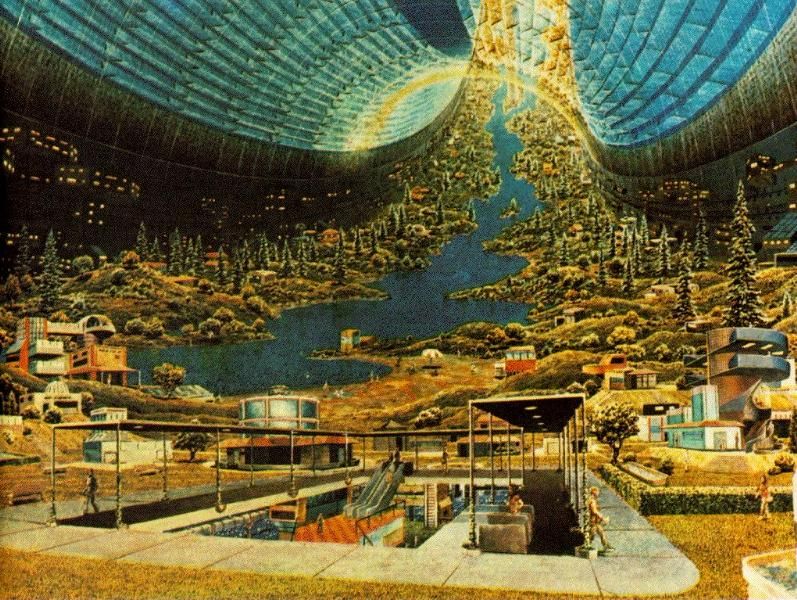
While the ISS would remain in its current state, partly for costs and partly to serve as a microgravity research space, two new layouts for a stellar settlement emerged. Both of these would use the centrifugal force of rotation to keep their inhabitants grounded, with the smaller proposal, a torus-shaped station, proposed by Stanford University and named after them.
This rotating wheel design would be 1.8 kilometers in diameter and make a full rotation every minute, simulating the conditions for Earth-like gravity. Ships would dock at the central axle, which would be a stable location, and settlers would enter the torus through its spokes. Humans also need a healthy level of sunlight to live in the space habitat, and a large mirror positioned to shine on one side of the wheel would provide the increased illumination needed to grow trees and farmland.

Alongside the Stanford torus, another much larger design would appear in novels speculating the creation of space settlements. Physicist Robert O’Neill proposed three ideas for a space colony in his book The High Frontier, but out of this selection the third would stand out the most: a habitat which stretched the torus shape into a rotating tube.
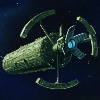
Described in lavish detail, this cylindrical structure would soon bear his name as the proposal spread to science fiction. The design was massive, 6.4 kilometers wide and 32 kilometers long, large enough that its rotation would feel barely noticeable. It consisted of a tube split into six parts, half of which were habitable land and the other half windows into space, allowing light in from bar-shaped mirrors which would pass as the structure rotated. Each part of the colony was meticulously planned out in O’Neill’s proposal, down to public services and area zoning for each square kilometer.
This massive scale was considered a logical step once the first hurdles of spaceflight were conquered — after all, the stars have far more resources than any on Earth. The Moon alone has vast quantities of titanium and aluminum, and stray asteroids could be mined out for bounties of rare metals not seen on Earth. Power would be a worry of the past, as satellites could harvest energy from the Sun at unprecedented rates. Humanity could become unburdened by worries of the past
O’Neill’s cylinder became an icon of space age optimism, and the space colony became a symbol of both ambition and a level of decadence, a hubris that instead of fixing Earth’s problems, we would just pack up and leave it. Although a realist take might say that the world could never agree enough to ever put something as large together, the ideas instilled by these symbols of unity may be the first step we will need to realize them.