In the same times nuclear rockets were being ruled out as too grandiose, space programs were coming to a new conclusion: chemical rockets were also too expensive to keep launching, let alone a giant atomic spaceship. But with a newfound interest in orbital industries with the satellite boom and the construction of the International Space Station, ambitious proposals were once again being floated in the field of space development.
The space elevator, a cable which would stretch all the way from the earth to orbit, quickly became a well-known science fiction centerpiece. However, as something this long was seen as unrealistic to create with current materials, a more modest proposal would see light over the coming decades. If a cable can’t reach the distance to land, a fast-moving airplane might be able to cover the remaining height.
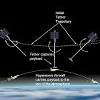
The skyhook would be the imagined result of this pairing, a rotating cable which would intersect with Earth’s atmosphere. The entire assembly would vertically spin, dipping into the sky at rendezvous points where a hypersonic craft could dock with the cable. Only a third of the length required for a full space elevator would be needed — one third for the rotation downwards, one for swinging upwards, and the last made up for by delivering the payload via jet, cutting out the need for a rocket and saving massively on fuel.
Although the space elevator remains firmly planted in the realm of fiction, studies on the skyhook’s feasibility found that such a cable would not be as far off as one might think, with proof-of-concept research in 2000 devising a plan which could be constructed with modern materials. Although building it would be an undertaking many times larger than any satellite, it may not be that far away.