Imagine, if you will, the next step of space travel. You need a bigger rocket, and rocket fuel can only go so far. What’s the next step? What’s a better mode of transportation, one attainable in the here and now?
A nuclear explosion, of course.
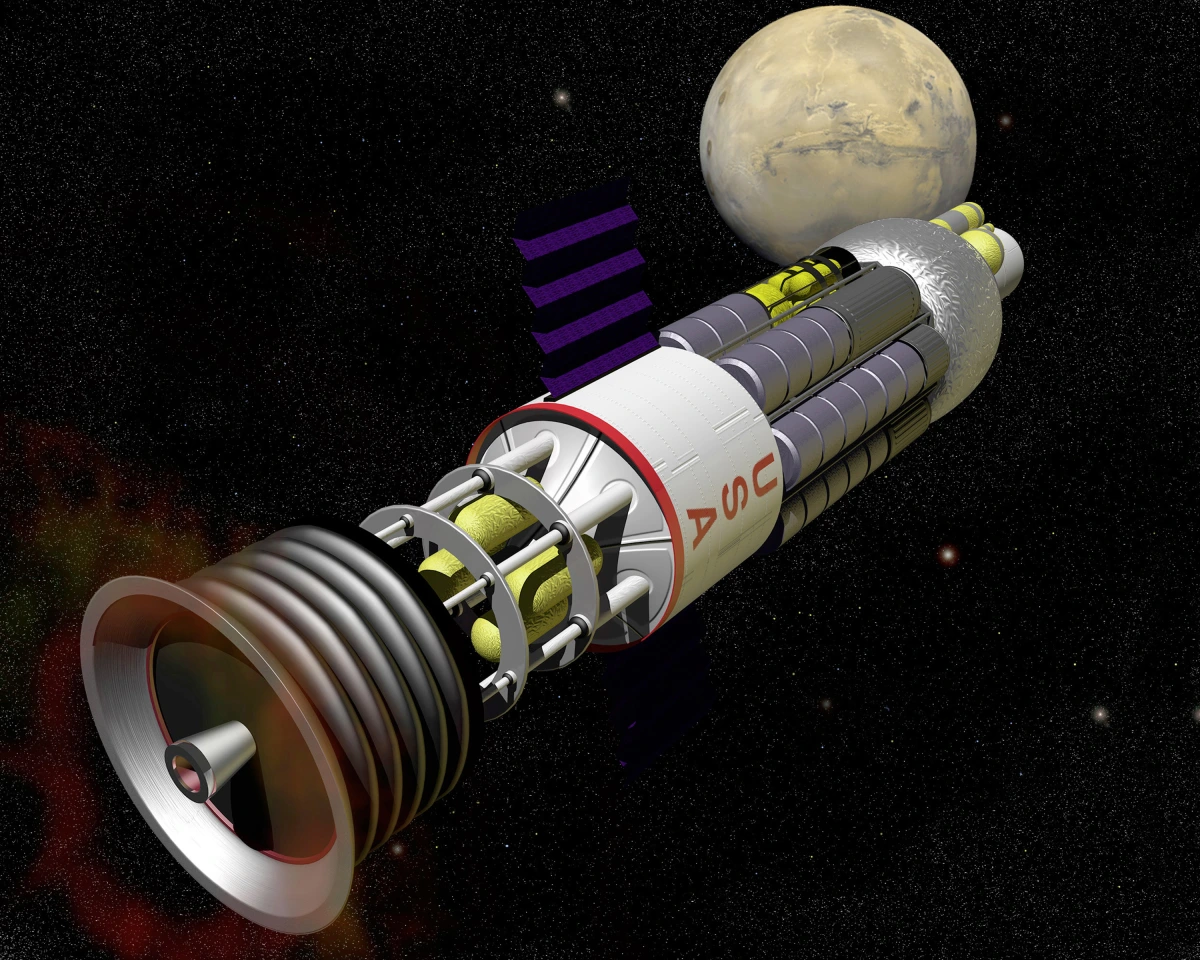
Conceptualized by Frederick Reines and Stanislaw Ulam in the 1950s, the Orion spacecraft is a theoretical ship which would be propelled by a series of atomic bombs detonating behind it. Each nuclear charge is shaped to funnel the explosion into a cylinder, literally pushing force outwards onto large metal plates at the rear of the vessel. This process would repeat at a cycle of 1 bomb per second, with a drafted human-crewed design requiring 800 explosions at 0.15 kilotons each to reach orbit.
Unlike with standard chemical rockets, the Orion propulsion system could only get more efficient the larger the design planned. After all, an explosion grows exponentially with payload, and so would the force generated by directing it.
Despite its seemingly absurd nature, the proposal was in the end a more practical concept for the future of spaceflight — both efficient and feasible for its time. However, growing concerns about the side effects of nuclear power, alongside a treaty to ban the use of atomic bombs across both countries of the Cold War, would shutter the project for good by the early 1960s. And so, Orion would be relegated to a bizarre anecdote in the space race.
Though it never left the drawing board, the sheer absurdity of a bomb powered spacecraft captured the minds of many sci-fi authors and directors. The idea was considered in the making of 2001: A Space Odyssey, but ultimately was seen as bordering on parody. Other space media, like Starsector, treat the idea as a comedic take on space travel more than anything else. While today Orion might be seen as somewhat of a joke, it is a joke which proves that sometimes truth can be stranger than fiction.